Sunday, July 17, 2011

Hatch #3 a Success--Black Java Broodies Rock!

This hatch is our third since April. This time around, our broody was Minerva, my faithful and lovely Black Java hen. She loves to sit in a heat wave. In fact, I've learned to expect 100+ temps when she starts puffing up and clucking monotonously in the best box.


Minerva has a special place in my heart. She epitomizes the qualities that made Black Javas a standard breed among early American homesteaders. She is calm, slightly aloof, and doesn't get into squabbles with other hens. She forages successfully and is very watchful while free ranging. And she goes broody like clockwork, is relatively cheerful about being isolated during the gestation period, and mothers her chicks like she was born to do it.

I gave Minerva 15 eggs and 7 hatched despite several being cracked or crushed by other unnamed hens (looking at you, Mahalia, since you loooooove to lay your daily egg with a big clutch of someone else's eggs, and squabbled with Minerva daily to do just that, often leaving a broken egg behind.)

I took Minerva's chicks Inside on day 19 after seeing a bunch of tiny red ants all over the nest, since I had a couple of pips didn't want to take a chance on some horrible fate claiming these babies (especially after losing the last batch when they were orphaned by a very hungry fox.)

Proud to say that of the 8 eggs that made it to day 18, 7 hatched.


YouTube Video

osted using BlogPress from my iPhone

Monday, July 4, 2011

Candling Day for the New Clutch of Eggs


Candling Day! Minerva had 15 eggs under her until Saturday, when I found one broken. All the eggs had to be removed from the nest and washed in hot soapy water yesterday, and when I did that I found one with cracks. (I removed it not only because I thought it would not incubate properly, but because the extensive cracking meant Minerva was likely to break it and get the rest if the eggs dirty again. Upon inspection, it was infertile). So we were down to 13 eggs and I decided today was a good day to candle them. I was particularly curious about one egg that has a tiny hole in it.

To candle, you want to make sure your eggs are at least 6 or 7 days along. It's easiest to see movement on days 7-14 in my opinion. After that the egg is mostly just a dark mass, at least with my off the shelf camping flashlights that are nothing fancy in the lumens department like some you can buy! I got my light, my chicken notebook where I keep track of stats and stuff about my two flocks, a sharp pencil, and set all that up in the bathroom, which doesn't have a window and gets VERY dark...best for candling!

I took about half the eggs from under Minerva and brought them inside. This was all the blue eggs. I candled them and found to my disappointment that only one of Ruth's four eggs was still viable--and I'm not even sure about that one. Many Easter Egger and other blue egg layers have an egg that just isn't easy to candle. I could definitely tell those that were infertile or never began to develop though--they were light colored and translucent throughout, with no really dark masses inside. You'll see chicken people refer to these as "clears" but the yolk is in there too, a light golden color that doesn't add much darkness or shadow when candling. I cracked the two clears and sure enough they still looked like the eggs I had for breakfast. I made a note that Jules, the FCBM roo, doesn't seem to be making Ruth's eggs fertile. Only one of her four looks possibly viable. I had noted that when he covers her it doesn't seem to work well. She has a crippled foot and he is a big roo...I don't think everything is coming together as it should. On the other hand, all of Esme's eggs looked viable, so it seems to be that Jules is fertile, but just isn't making a consistent love connection with Ruth. This is disappointing because Ruth lays the biggest bluest egg if any of my adult hens, and she lays a lot of them, about 6 each week, even in the worst heat. These are traits I wanted to pass on to Olive Egger line, but Esmeralda's eggs are big too and she is also a prolific layer, at 5-6 per week. Her egg just isn't as pretty a shade of blue. When my Ameracauna babies start laying in the Fall, I can work on adding more blue to the line.

After candling, I put 4 EE eggs back under Minerva. These are my only chances this Spring for a few more Olive Eggers for my line, since I lost three when I had to rehome Gypsy's babies after she was taken by the fox. This will be my third hatch this year, and I only have one OE to show for it, and she won't lay and show her egg color until September or October. Babies born from this hatch won't lay until mid-winter. Working on a new line of birds is time consuming!

After returning the OE eggs, I took out the seven Black Javas and took them inside to candle. One had an obvious blood ring...a mostly clear egg with one dark line encircling the entire inside like an equatorial line. This was a sure sign that growth had begun but subsequently ended and the chick had died.


Sure enough, a tiny embryo was inside. This shows that development ceased after just a few days. The picture shows clearly the nature of the inner air membrane too, which the hatching chick pecks into to get the first breath of air that will sustain it as it rests and then pips through the external membrane and shell.

As usual, I was very pleased with my Black Javas. Of 7 eggs, 6 were obviously alive and very active. Even the one labeled Maeve 25, with a tiny hole in it!


By the time I was done candling, Minerva's clutch was reduced to just 10. I am finding that although the broody mama has many advantages over incubating in a bator (especially since I really don't enjoy hand raising babies with their smell, mess, and fragility), the attrition rate of eggs under the broody is certainly higher than in a good bator. After all, in my last incubated hatch, 23 of 24 hatched and lived. But it seems a normal sized clutch for a mama hen is 5-10 babies...more would be pretty hard to cover, incubate, and take good care of! Since these babes will be hatching just before we begin two weeks of moving to a new home, I should probably be thankful that not all the eggs will make it to chickhood.


Tuesday, June 28, 2011

Broody Mama Take Two! Minerva Gets Serious About Hatching Eggs


It really is lucky that Minerva went broody just a few days before we lost Gypsy the mama hen to the foxes. She is now setting on 15 eggs: 8 Olive Eggers and 7 Black Javas. Because I do not want to raise Gypsy's orphan chicks myself (especially in the same month when we are moving) a friend is adopting them, leaving us back where we started two months ago--no chicks to replenish our egg line or build our breeding lines! So it's especially lucky that Minerva has volunteered to bring more into the flock. Her chicks should be born around the 15th of July.


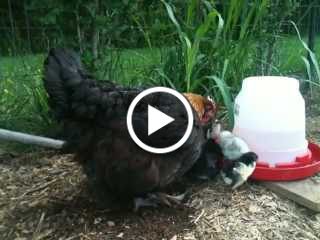
YouTube Video


This clip shows Minerva in all her broody glory, with a side of my daughter stealing the spotlight--she really needs to start her own chicken blog!

Posted using BlogPress from my iPhone


RIP Gypsy--Finally, We Lose Birds to the Local Foxes...


I am sad to report that we lost two good hens in the last two days. First, Maybell the Black Java pullet was not with the other birds when they came to the coops at dusk. We went looking and found a few piles of feathers in the field, and the last one had fresh droppings that we carefully gathered (without touching--animal scat can carry all kinds of nasty bacteria, larvae, and viruses) and researched online. Gray fox. The next night, we didn't get outside quite fast enough, and I found Gypsy's five babies in the coop alone. We looked around, and there in the field were two young foxes--teenagers, really--with her crumpled body, trying valiantly to drag her off.

These foxes are the offspring of the magic fox, as I called her, from last year. She wasn't afraid of me, and didn't make a move on my chickens, despite me having baby chicks that regularly frequented the field where she hunted fireflies. Come to think of it, it was almost exactly a year ago, and Gypsy was one of those chicks. The fox mother got within just a few feet of me and let me talk to her. She was really quite amazing, and I felt truly blessed to have a nightly encounter with her over the course of almost a whole month. Her children, however, are very normal foxes. They are super skittish--running away when we get within 100-200 feet of them, whereas their mother was often within 6 feet of me while I talked directly to her. And they, unlike her, are definitely interested in eating my chickens. This is their mother, last year (notice the sounds of chicks in the background--I am standing in the chicken yard).


What a great loss. Gypsy laid an amazingly large, deep brown, speckled egg, and she was a good broody, even if she did lose a couple babies her first time brooding. And she and Maybell were both purebred birds, and they made money for me with their eggs. But losing the mama for five babies was even worse. At four weeks of age, they aren't fully feathered out yet, and still need to be kept warm at night. Their sad little peeps as they looked for her all day today were really hard to hear. Worse, they lack the instinct to stay away from the shady creekbed where the foxes grabbed the two hens, and they are small enough to slip through the fence I closed off so that none of the bigger birds can go back there as they have all been accustomed to doing on a daily basis.

So all day I was on pins and needles wondering if they would be predated as well, and was unable to catch them all in the thicket of briars and vines that line the creekbed. What a stressful day! With my husband's help we did get them all back into the coop at dusk, and no birds were lost today--a goal I was not sure I would be able to achieve after losing two birds in two days! Still, I was happy to get a message from a friend tonight that she will take all five babies tomorrow. Five less things to try to keep alive! And with Minerva, who raised Gypsy, setting broody on a clutch of eggs, I'll have plenty to do without having five orphans on my hands.

Wednesday, June 1, 2011

Charming Family Life of Chickens

Watching Gypsy the mother hen bring her chicks out into the flock today was just a delight.

YouTube Video

Jules, the French Coppered Black Marans roo in our flock, is shown here. He is Gypsy's mate and the father of three of these chicks--and the father of all our Olive Eggers at this point. He is taking well to having the babes underfoot and can be seen calling them for a treat at one point.

YouTube Video

Everything seems to be going well. So glad these chicks are being raised by mama outside!


Monday, May 30, 2011

And Then There Were Six--Trial and Error with a Clumsy Mama Hen

Video of Mama and Babies
I almost hesitate to post this as the number may change again by tomorrow.  Since I last posted, I found another mortally wounded chick in Gypsy's nest, we had a very touching little funeral (mostly because the kids were with me when I found the dying chick), and I took the chicks AGAIN, for good.  Then I spent an hour or so breaking down the broody area and setting up the big terrarium inside for the remaining six chicks.  It's a chore--finding the right light to get the temp right meant going to the store to buy a bulb, since we really only have the new cool compact bulbs in the house nowadays, and I had to spend some time cat-proofing the brooder as it was going to be in the studio. No more chicks in the house, I've decided. 

Then I had to just accept the fact that I was raising chicks, AGAIN, and that was really a buzzkill.  But it seemed inhumane to hand helpless babies to a completely incompetent mother for whom negligent homicide was second nature.  Right?

I was pretty frustrated with Gypsy and had a very hard heart as I took the chicks and broke down her brooding area.  It was easy to ignore her thoughts on the matter.  But she was still digging in the coop's deep shavings 6 hours later when I put the birds up for the night, and I dreamed about her looking in the woods for them.  When I went out the next morning and let the flock out, she (normally a pretty standoffish bird) immediately came right up to my face as if to ask where they were.  Then she followed me around.  The insistent clucking--the noise a mother makes to get her chicks to come to her side was heartbreaking.  She hopped into the other coop and started digging it up.  Her babies, she was convince, were lost somewhere, and she wasn't giving up on them.  That, I understood.  My own heart, focused on mothering so keenly, couldn't ignore her.

I took some time to set up a new space for her, a separate pen from the rest of the flock, and got the babies from their isolette.  I took them to the pen in a pet carrier and opened the door..  The look on her face as she found them in her next clucking, scouting circle was priceless.

Video #2 of Mama and Baby Chicks
It was a hard decision.  But they are her babies, not mine.  I remember hearing my grandmother saying "I didn't take them to raise!" as a child when recounting a story of someone needing more help than she thought she should give.  It's a pretty powerful maxim.  I have three chicks of my own; baby, girlchild, and demi-man, and I have my hands full with them.  I take on all the stress of keeping them alive because they are mine, at least for a time, and they depend on me alone.  These chicks have a mother.  She may not be great, I thought, and she might even kill them accidentally, but she deserves a chance to raise them.  To be a mother.

I worried I would find one less chick this morning.  Or worse.  I worry that I'll find another dead or broken and dying chick tomorrow morning.  But it's her business, and I'm committed to letting go of the process.  I can't save everything. Knowing what and who I "took to raise" is wisdom I need to take to heart.

Video #3--Good night  Please, everyone be alive at dawn, ok?
As you've no doubt gathered from the pics and videos in this post, mama and babies were all fine this morning. This last video shows my last minutes with them yesterday evening, just as mama went in to the carrier for the night and I went in to the house crossing my fingers she was committed to taking them to raise.

Saturday, May 28, 2011

Success! 7 Healthy Chicks Peeping Under Broody Mama

Beware:  the cute in this video is intense.
Well, that was a hair-raising adventure.  After removing one chick from the nest whose egg was crushed as it hatched, so it could finish hatching in the incubator inside, and then finding the first, beautiful chick dead in the nest on the morning after it was born, I was very worried Gypsy might be a great broody, but lack mothering skills.  What's the point of having a hen hatch eggs, worrying about her getting on and off the eggs and keeping other birds away from her, providing separate food and water as needed, only to have to hand raise the chicks?  That would have been the worst of both worlds and the most time intensive choice imaginable in hatching babies. 

So it is with great happiness and relief that I report that I was able to transfer 3 chicks, the oldest 3 surviving, all Olive Eggers, to Gypsy yesterday, holding my breath that I would find them in a non-mashed state at dawn.  I hoped by that time that the newly hatched Black Javas in the incubator would be ready to transfer, if all went well.

 This short clip shows Gypsy's response when I put a very fiesty day old under her (the aforementioned chick of Esmerelda Weatherwax, my very favorite hen, who was a strong as a small horse after being allowed to hatch and recuperate in the incubator).


Here is what I found this morning when I went out.

Gypsy has the hang of mothering.  I put the other four under her and she seems as happy as can be, clucking and settling around them.  There should be an idiom for happiness and contentment that refers to a mother hen when her chicks have hatched and are safely tucked beneath her, peeping and peeking out at the world.  Sigh.  I may have found my spirit animal.

Enjoy the pics.  I'll post more when she decides to bring them out to meet the rest of the flock.