Tuesday, June 28, 2011

Broody Mama Take Two! Minerva Gets Serious About Hatching Eggs


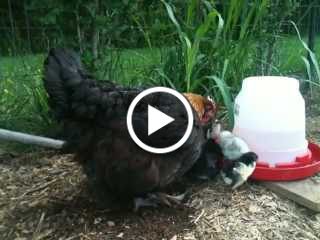
It really is lucky that Minerva went broody just a few days before we lost Gypsy the mama hen to the foxes. She is now setting on 15 eggs: 8 Olive Eggers and 7 Black Javas. Because I do not want to raise Gypsy's orphan chicks myself (especially in the same month when we are moving) a friend is adopting them, leaving us back where we started two months ago--no chicks to replenish our egg line or build our breeding lines! So it's especially lucky that Minerva has volunteered to bring more into the flock. Her chicks should be born around the 15th of July.


YouTube Video


This clip shows Minerva in all her broody glory, with a side of my daughter stealing the spotlight--she really needs to start her own chicken blog!

Posted using BlogPress from my iPhone


RIP Gypsy--Finally, We Lose Birds to the Local Foxes...


I am sad to report that we lost two good hens in the last two days. First, Maybell the Black Java pullet was not with the other birds when they came to the coops at dusk. We went looking and found a few piles of feathers in the field, and the last one had fresh droppings that we carefully gathered (without touching--animal scat can carry all kinds of nasty bacteria, larvae, and viruses) and researched online. Gray fox. The next night, we didn't get outside quite fast enough, and I found Gypsy's five babies in the coop alone. We looked around, and there in the field were two young foxes--teenagers, really--with her crumpled body, trying valiantly to drag her off.

These foxes are the offspring of the magic fox, as I called her, from last year. She wasn't afraid of me, and didn't make a move on my chickens, despite me having baby chicks that regularly frequented the field where she hunted fireflies. Come to think of it, it was almost exactly a year ago, and Gypsy was one of those chicks. The fox mother got within just a few feet of me and let me talk to her. She was really quite amazing, and I felt truly blessed to have a nightly encounter with her over the course of almost a whole month. Her children, however, are very normal foxes. They are super skittish--running away when we get within 100-200 feet of them, whereas their mother was often within 6 feet of me while I talked directly to her. And they, unlike her, are definitely interested in eating my chickens. This is their mother, last year (notice the sounds of chicks in the background--I am standing in the chicken yard).


What a great loss. Gypsy laid an amazingly large, deep brown, speckled egg, and she was a good broody, even if she did lose a couple babies her first time brooding. And she and Maybell were both purebred birds, and they made money for me with their eggs. But losing the mama for five babies was even worse. At four weeks of age, they aren't fully feathered out yet, and still need to be kept warm at night. Their sad little peeps as they looked for her all day today were really hard to hear. Worse, they lack the instinct to stay away from the shady creekbed where the foxes grabbed the two hens, and they are small enough to slip through the fence I closed off so that none of the bigger birds can go back there as they have all been accustomed to doing on a daily basis.

So all day I was on pins and needles wondering if they would be predated as well, and was unable to catch them all in the thicket of briars and vines that line the creekbed. What a stressful day! With my husband's help we did get them all back into the coop at dusk, and no birds were lost today--a goal I was not sure I would be able to achieve after losing two birds in two days! Still, I was happy to get a message from a friend tonight that she will take all five babies tomorrow. Five less things to try to keep alive! And with Minerva, who raised Gypsy, setting broody on a clutch of eggs, I'll have plenty to do without having five orphans on my hands.

Wednesday, June 1, 2011

Charming Family Life of Chickens

Watching Gypsy the mother hen bring her chicks out into the flock today was just a delight.

YouTube Video

Jules, the French Coppered Black Marans roo in our flock, is shown here. He is Gypsy's mate and the father of three of these chicks--and the father of all our Olive Eggers at this point. He is taking well to having the babes underfoot and can be seen calling them for a treat at one point.

YouTube Video

Everything seems to be going well. So glad these chicks are being raised by mama outside!


Monday, May 30, 2011

And Then There Were Six--Trial and Error with a Clumsy Mama Hen

Video of Mama and Babies
I almost hesitate to post this as the number may change again by tomorrow.  Since I last posted, I found another mortally wounded chick in Gypsy's nest, we had a very touching little funeral (mostly because the kids were with me when I found the dying chick), and I took the chicks AGAIN, for good.  Then I spent an hour or so breaking down the broody area and setting up the big terrarium inside for the remaining six chicks.  It's a chore--finding the right light to get the temp right meant going to the store to buy a bulb, since we really only have the new cool compact bulbs in the house nowadays, and I had to spend some time cat-proofing the brooder as it was going to be in the studio. No more chicks in the house, I've decided. 

Then I had to just accept the fact that I was raising chicks, AGAIN, and that was really a buzzkill.  But it seemed inhumane to hand helpless babies to a completely incompetent mother for whom negligent homicide was second nature.  Right?

I was pretty frustrated with Gypsy and had a very hard heart as I took the chicks and broke down her brooding area.  It was easy to ignore her thoughts on the matter.  But she was still digging in the coop's deep shavings 6 hours later when I put the birds up for the night, and I dreamed about her looking in the woods for them.  When I went out the next morning and let the flock out, she (normally a pretty standoffish bird) immediately came right up to my face as if to ask where they were.  Then she followed me around.  The insistent clucking--the noise a mother makes to get her chicks to come to her side was heartbreaking.  She hopped into the other coop and started digging it up.  Her babies, she was convince, were lost somewhere, and she wasn't giving up on them.  That, I understood.  My own heart, focused on mothering so keenly, couldn't ignore her.

I took some time to set up a new space for her, a separate pen from the rest of the flock, and got the babies from their isolette.  I took them to the pen in a pet carrier and opened the door..  The look on her face as she found them in her next clucking, scouting circle was priceless.

Video #2 of Mama and Baby Chicks
It was a hard decision.  But they are her babies, not mine.  I remember hearing my grandmother saying "I didn't take them to raise!" as a child when recounting a story of someone needing more help than she thought she should give.  It's a pretty powerful maxim.  I have three chicks of my own; baby, girlchild, and demi-man, and I have my hands full with them.  I take on all the stress of keeping them alive because they are mine, at least for a time, and they depend on me alone.  These chicks have a mother.  She may not be great, I thought, and she might even kill them accidentally, but she deserves a chance to raise them.  To be a mother.

I worried I would find one less chick this morning.  Or worse.  I worry that I'll find another dead or broken and dying chick tomorrow morning.  But it's her business, and I'm committed to letting go of the process.  I can't save everything. Knowing what and who I "took to raise" is wisdom I need to take to heart.

Video #3--Good night  Please, everyone be alive at dawn, ok?
As you've no doubt gathered from the pics and videos in this post, mama and babies were all fine this morning. This last video shows my last minutes with them yesterday evening, just as mama went in to the carrier for the night and I went in to the house crossing my fingers she was committed to taking them to raise.

Saturday, May 28, 2011

Success! 7 Healthy Chicks Peeping Under Broody Mama

Beware:  the cute in this video is intense.
Well, that was a hair-raising adventure.  After removing one chick from the nest whose egg was crushed as it hatched, so it could finish hatching in the incubator inside, and then finding the first, beautiful chick dead in the nest on the morning after it was born, I was very worried Gypsy might be a great broody, but lack mothering skills.  What's the point of having a hen hatch eggs, worrying about her getting on and off the eggs and keeping other birds away from her, providing separate food and water as needed, only to have to hand raise the chicks?  That would have been the worst of both worlds and the most time intensive choice imaginable in hatching babies. 

So it is with great happiness and relief that I report that I was able to transfer 3 chicks, the oldest 3 surviving, all Olive Eggers, to Gypsy yesterday, holding my breath that I would find them in a non-mashed state at dawn.  I hoped by that time that the newly hatched Black Javas in the incubator would be ready to transfer, if all went well.

 This short clip shows Gypsy's response when I put a very fiesty day old under her (the aforementioned chick of Esmerelda Weatherwax, my very favorite hen, who was a strong as a small horse after being allowed to hatch and recuperate in the incubator).


Here is what I found this morning when I went out.

Gypsy has the hang of mothering.  I put the other four under her and she seems as happy as can be, clucking and settling around them.  There should be an idiom for happiness and contentment that refers to a mother hen when her chicks have hatched and are safely tucked beneath her, peeping and peeking out at the world.  Sigh.  I may have found my spirit animal.

Enjoy the pics.  I'll post more when she decides to bring them out to meet the rest of the flock.


Friday, May 27, 2011

Sad News for Gypsy's First Babe, and an Intervention

The chick I removed from Gypsy's nest yesterday, an adorable white or silver baby, has been in the incubator for 12 hours.  It has kicked the rest of its shell off, and is FINALLY trying to stand. I am still not sure about the viability of this chick, as it seems very very weak.

That's at least somewhat hopeful.  I hate to report that the beautiful Black Java chick that was healthy and strong last night was dead in the nest this morning.  I guess it was crushed by Gypsy.

With 0/2 chicks healthy and strong,I made the decision to take Gypsy's remaining pipped eggs and put them in the bator with the weak chick.   There are three Black Javas and two from a truly elegant silver (blue) bird named Nanny Ogg, a prolific light blue egg layer. 

I plan to give Gypsy's chicks back once all the eggs in her nest are hatched...or I may give these to her once they hatch, and take the unhatched eggs from her at that point and try to hatch them inside and then give her a second helping of babies tonight or tomorrownight, depending how the timeline goes.

I have no way of knowing what happened.  But my gut tells me that the weak chick got stepped on or mashed a bit as it was hatching, and the Black Java was flat over an egg.  I think Gypsy may be having trouble with the combination of eggs and chicks at the same time.

Update later.  Sad morning.

Update, 9:30 am
Esme's chick is spending more and more time on her feet.  She has been joined in the incubator by a new hatchling, Nanny Ogg's baby.  Looks to be silver but she isn't dry enough yet to really tell.  Both these girls should lay Olive Eggs.  Two more Black Java eggs have sizable pips.

Thursday, May 26, 2011

Gypsy's Hatch--Tale of a First Time Broody

I am so proud of my girl!  It's been a bumpy road, and we've lost a few eggs, but Gypsy is sitting pretty on a clutch of peeping eggs and one cute, wet Black Java chick.


Gypsy has been a dedicated broody.  I've taken her off the nest daily as she just wasn't interested in meeting her own daily needs--a sure sign of a hard-core broody instinct.  I'm sure she would have hit her own wall at some point and left the nest to take care of her business and fed and watered, but she never willingly hopped up and off the eggs when I was around, and I didn't want to just leave her nest area open to the world while I was gone for long periods, so I dutifully put her down on the ground every morning and late afternoon.

The three times I left her out (and her nest box accessible to her should she want to get back to setting before I returned) to run around a bit while I attended to other matters around the house or garden, I came back to find a cracked egg.  I was down to 12 eggs by day 17/18 (remember, I set eggs over the course of two days), when the worst happened.

I let Gypsy out that the morning and then put her back in and locked her door, thinking she was safe in her 4 ft high circle of hardware cloth that bounded her nest area, along with her food and water and some bathroom space should she need it (a good idea for a broody's area--if she doesn't have enough space to go and she ever really has to, it can get on the eggs and create a huge smelly mess that has to be cleaned up, increasing your chance of bad eggs and of disturbing the broody away from her work).

But I left the lower front door to the coop open--the one that the other hens use to get in to lay eggs.  They were still separated from Gypsy by the Wall of Broody hardware cloth, so I wasn't concerned about it.  Mistake #1.

I left for work around 10 am and didn't return until almost 6 pm.  I found Gypsy out with the rest of the flock and her door locked as I had left it.  In her nest was a broken egg with a fully formed and perfect baby Black Java inside. The rest were cold, cold, cold.  I deduced that another hen had come into the coop, flown up onto a roost (very odd behavior during the day) and over her fenced in area and tried to lay in her nest or take her eggs for her own.  A struggle ensued (at least in my imagined re-enactment) and a baby was killed.  Gypsy was "spooked off her nest" as broodies sometimes are by this kind of entanglement, and flew up and over the hardware cloth (though I've never seen her fly up four feet and she's pretty weak, it had to happen like that, or she wouldn't have been out) and then couldn't figure how to get back over and in. Regardless of what really happened, her eggs were cold and, I felt sure, dead.

I went to bed heartsick, after putting Gypsy back on her eggs (and she immediately went back to brooding like nothing had happened).  The next day I candled the eggs and to my surprise, 2 of the random 4 I picked out were definitely alive.

And today two hatched!  It's day 19/20.  One, a healthy Black Java, is under mama's wing right now, and I saw a pip in a second BJ tonight. One, an Olive Egger from my beautiful (and favorite) hen Esmerelda Weatherwax, hatched but is not thriving.  I put it into an incubator inside to see if it can perk up--details soon.

I expect several more chicks to hatch in the next two days.  I hope the extended untended period hasn't created any weakness in the chicks....